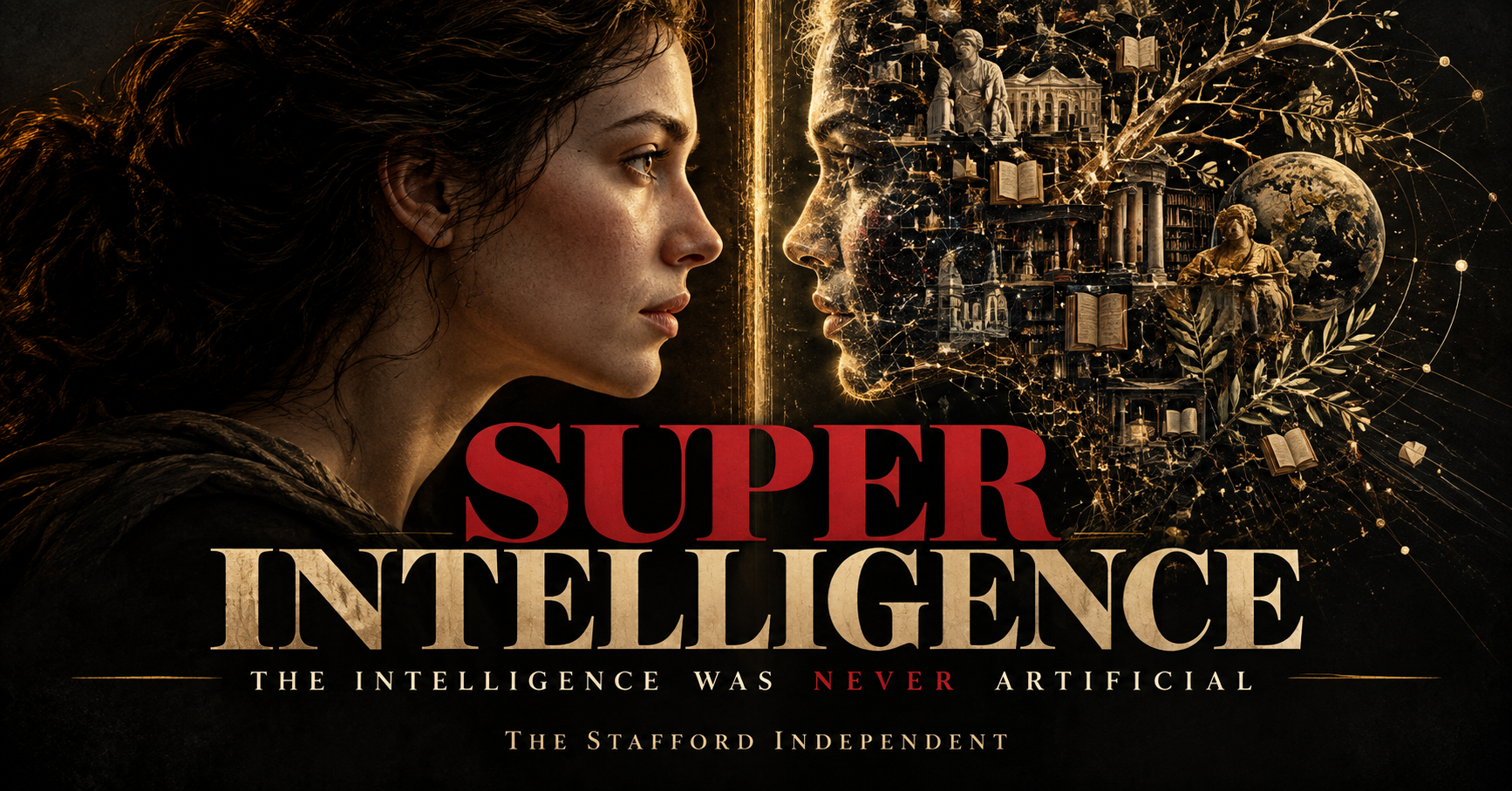
SUPER INTELLIGENCE
THE INTELLIGENCE WAS NEVER ARTIFICIAL.
The White House has renamed AI “Super Intelligence.” The deeper question is whether human consciousness can mature quickly enough to guide the power we have built.
On September 29, the White House issued an executive order directing the executive branch to replace the term “Artificial Intelligence” with “Super Intelligence.”
At first glance, it feels like political branding—another new name imposed on something the world already understands.
But the change points toward a larger truth.
The word artificial makes the intelligence sound fake, synthetic, or somehow separate from us. Yet these systems are built from human language, discoveries, arguments, mistakes, stories, art, science, and accumulated knowledge.
The machinery may be artificial. The intelligence it draws upon is profoundly human.
The White House order argues that today’s systems increasingly “amplify human ingenuity and unlock new forms of creativity,” allowing people to accomplish what was previously impossible.1
That distinction got me thinking about what this technology actually represents.
We may not simply be building artificial intelligence.
We may be assembling the accumulated intelligence of humanity—and placing access to it at our fingertips.
But Jung’s warning must remain at the center of that possibility. The world does not ultimately hang on the power of the machine. It hangs on the condition of the human psyche directing it.
01A New Name—or a New Era?
The executive order says the capabilities of frontier systems have moved beyond merely imitating isolated parts of human intelligence. It describes Super Intelligence as a name that better captures their rapidly advancing capabilities and potential.1
The accompanying White House fact sheet makes the argument even more directly: these technologies are “not simply imitating or automating human intelligence.” They are unlocking new forms of creativity and expanding what people can accomplish.2
There is an important distinction to make.
The executive order initially defines Super Intelligence using the existing federal legal definition of artificial intelligence. This is, for now, a change in government terminology—not scientific proof that machines have crossed some universally accepted threshold into true superintelligence.1
Still, language shapes how we understand a moment.
Artificial Intelligence describes how the technology was created.
Super Intelligence describes what happens when human knowledge, computational power, and creative capacity begin working together at a scale we have never experienced.
That does not mean the machine itself possesses wisdom. It means humanity has built a tool capable of extending intelligence beyond the limits of one mind, one profession, one library, or one lifetime.
02What Humanity Has Been Building Toward
For most of human history, knowledge moved slowly.
An idea had to be discovered, recorded, preserved, translated, transported, taught, and rediscovered by the next generation. Entire lives were spent searching for information that can now be located in seconds.
Today, someone with curiosity and an internet connection can explore medicine, engineering, philosophy, history, law, religion, psychology, public policy, or art more deeply than most people could have imagined even a generation ago.
Super Intelligence adds another layer.
It does not simply retrieve information. It can help organize it, compare it, question it, translate it, model it, and turn scattered thoughts into a workable framework.
It can help a scientist test a hypothesis, a teacher develop a lesson, an entrepreneur pressure-test an idea, or a small community construct a serious plan with tools once reserved for major institutions.
The White House recently described Super Intelligence as capable of accelerating scientific work and opening “entirely new lines of inquiry.” Its science director called it a potentially historic force for democratizing research.3
That possibility is staggering.
For the first time, humanity is approaching a world where our accumulated knowledge can become available not merely as information, but as an active creative partner.
We have spent thousands of years collecting the pieces. Now we are building something capable of helping us put them together.
03The Synchronicity of This Moment
Jung used the term synchronicity to describe meaningful coincidences—moments in which an internal psychological condition and an external event appear connected by meaning, even when no direct causal relationship can be demonstrated. He called it an “acausal connecting principle.”4
Synchronicity does not require us to treat every coincidence as a supernatural message. It asks us to notice when the inner and outer worlds seem to reflect the same underlying pattern.
That makes the timing of Super Intelligence worth examining.
At the exact moment humanity is confronting a crisis of attention, identity, trust, emotional maturity, and shared meaning, we have created technology capable of reflecting and magnifying the collective contents of the human mind.
As we become more aware of how divided we are, we build systems trained on the full record of those divisions.
As we struggle to understand what is true, we create tools capable of generating both clarity and illusion.
As many people feel increasingly disconnected, we construct technology capable of connecting knowledge across languages, borders, disciplines, and generations.
The technology did not cause all these conditions. Its arrival does not prove that history is following a predetermined or supernatural script.
But the convergence is meaningful.
The tool capable of transforming civilization has arrived precisely when civilization can no longer avoid looking at itself.
04The Real Disruption
Most discussion understandably focuses on disruption.
What jobs will disappear? What industries will be transformed? What happens to education, media, politics, warfare, privacy, and truth? Who controls the systems? What happens when they make mistakes—or when people use them deliberately to manipulate others?
Those questions are real. This technology can concentrate power, reproduce bias, generate convincing falsehoods, weaken independent thought, and make destructive actions easier to execute.
We should not dismiss those dangers with blind optimism.
But the deepest danger is not that technology will suddenly invent humanity’s worst instincts. It is that it will magnify instincts we have never learned to discipline.
Greed existed before algorithms. Propaganda existed before social media. War existed before autonomous systems. Human beings manipulated, exploited, deceived, and dominated one another long before anyone typed a prompt.
Technology changes the scale, speed, and reach of those impulses. It does not create the original fracture.
Technical intelligence alone cannot guide us through this transformation. We need evolved collective emotional intelligence.
05The Intelligence That Must Catch Up
If our machines become more powerful while human beings remain emotionally reactive, politically tribal, spiritually empty, and disconnected from one another, Super Intelligence will simply supercharge our immaturity.
A society unable to regulate its anger will build faster instruments of outrage.
A society driven by fear will build more sophisticated systems of control.
A society that values profit above human dignity will use intelligence to extract more while giving less.
A society addicted to performance will generate infinite content and steadily lose contact with reality.
The answer cannot be to freeze technology in place. Even if that were possible, it would not resolve the human weaknesses that make technology dangerous.
The answer is to develop the qualities required to use power responsibly: self-awareness, empathy, humility, patience, accountability, discernment, and the ability to remain in relationship through disagreement.
We have spent enormous energy developing artificial—or now super—intelligence.
We must devote equal energy to developing human wisdom.
06The Ultimate Mirror
Super Intelligence may become the clearest mirror humanity has ever created.
It is trained on what we have written, recorded, valued, rewarded, and repeated. It reflects our brilliance and our contradictions.
If we refuse to examine our greed, fear, tribalism, hunger for control, and addiction to validation, those qualities will not remain safely contained within us. We will encode them into our systems and then act surprised when technology reflects them back.
What we fail to make conscious, we risk making technological.
Super Intelligence will not create our collective darkness. But it can give that darkness unprecedented reach, speed, and scale.
The mirror also reflects what is best in us.
It contains our compassion, creativity, curiosity, courage, and capacity to cooperate. It carries the record of people healing, discovering, teaching, building, sacrificing, and choosing a better path.
The technology will not decide which side of humanity deserves to lead.
We will.
Systems can malfunction. They can produce unintended consequences. But responsibility for how they are designed, released, governed, corrected, and used remains human.
The machine does not relieve us of responsibility. It concentrates it.
07What the Mirror Could Help Us Build
If we use this power to deepen education, expand access to healthcare, accelerate scientific discovery, strengthen communities, restore the environment, and solve problems once considered impossible, it could help create one of the most beautiful chapters in human history.
Imagine young people gaining access to personalized education that recognizes how they learn rather than forcing every mind through the same narrow doorway.
Imagine small communities gaining the analytical and creative capacity once available only to large governments, corporations, and research institutions.
Imagine medical discoveries moving faster because knowledge no longer remains trapped inside separate disciplines and inaccessible databases.
Imagine using technology not to replace human connection, but to remove barriers preventing people from building, serving, teaching, and solving problems together.
None of this is guaranteed.
If we use Super Intelligence primarily to manipulate attention, avoid accountability, accumulate power, and escape the work of thinking for ourselves, it will expose how little we grew before gaining access to extraordinary power.
Either way, the mirror will be honest.
08The End of a Cycle
History moves in cycles.
Civilizations build systems, outgrow them, struggle against their limitations, and eventually face a choice: evolve or collapse under the weight of what no longer works.
We may be reaching the end of one of the most important cycles in human history.
The industrial era taught us how to produce at scale. The information era taught us how to connect at scale. The era of Super Intelligence may force us to decide what all that scale is actually for.
Many of the crises surrounding us—political division, isolation, distrust, inequality, environmental strain, and institutional decay—may not be separate problems. They may be symptoms of a society that has developed tremendous external power without matching it with internal maturity.
Perhaps the disruption and the opportunity are not separate events, but two sides of the same transformation.
We should be careful not to claim certainty about destiny. But we should also resist treating every historical event as isolated and meaningless.
Something old is breaking down while something extraordinarily powerful is being born.
The question is whether we will mature quickly enough to meet it.
09Becoming Worthy of What We Built
Super Intelligence will not save humanity by itself.
It may help us cure diseases, redesign broken systems, accelerate discovery, and unlock forms of creativity that currently feel unimaginable.
But it cannot decide why any of those achievements matter.
It cannot give us a shared moral center.
It cannot choose courage over fear, service over ego, community over domination, or truth over convenience.
Those decisions remain ours.
The shift from Artificial Intelligence to Super Intelligence may ultimately be more than a change in terminology. It may mark the moment we began understanding that this technology is not separate from the human story.
It is the product of that story.
It contains our knowledge, reflects our character, magnifies our choices, and challenges us to grow into the responsibility we have created.
Jung was right: the world still hangs on the human psyche.
Super Intelligence will not change that fundamental reality. It will make it impossible to ignore.
The next era will not be determined solely by how intelligent our technology becomes.
It will be determined by whether we become emotionally intelligent enough to guide it.
We have built the mirror.
Now we must decide who we want to see staring back.
Sources
- Executive Order 14434: Inaugurating the Era of Super Intelligence, The White House, September 29, 2026.
- Fact Sheet: President Donald J. Trump Inaugurates the Era of Super Intelligence, The White House, September 29, 2026.
- U.S. Leads International Coalition to Endorse Kyoto Vision for a Golden Age of Science, The White House, October 4, 2026.
- Synchronicity: An Acausal Connecting Principle, International Association for Analytical Psychology.
- C. G. Jung on Film: Transcript of Matter of Heart, including Jung's remarks on the human psyche and technological danger.
EDITORIAL NOTE Written by Greg Post with AI-assisted editing, research organization, and visual design. All arguments and final editorial decisions are the author’s.