The Common Ground Is Health
Bernie Sanders, Robert F. Kennedy Jr., and the unlikely idea that could help America heal.
Written by Greg Post · Published October 9, 2026 · 11 minute read
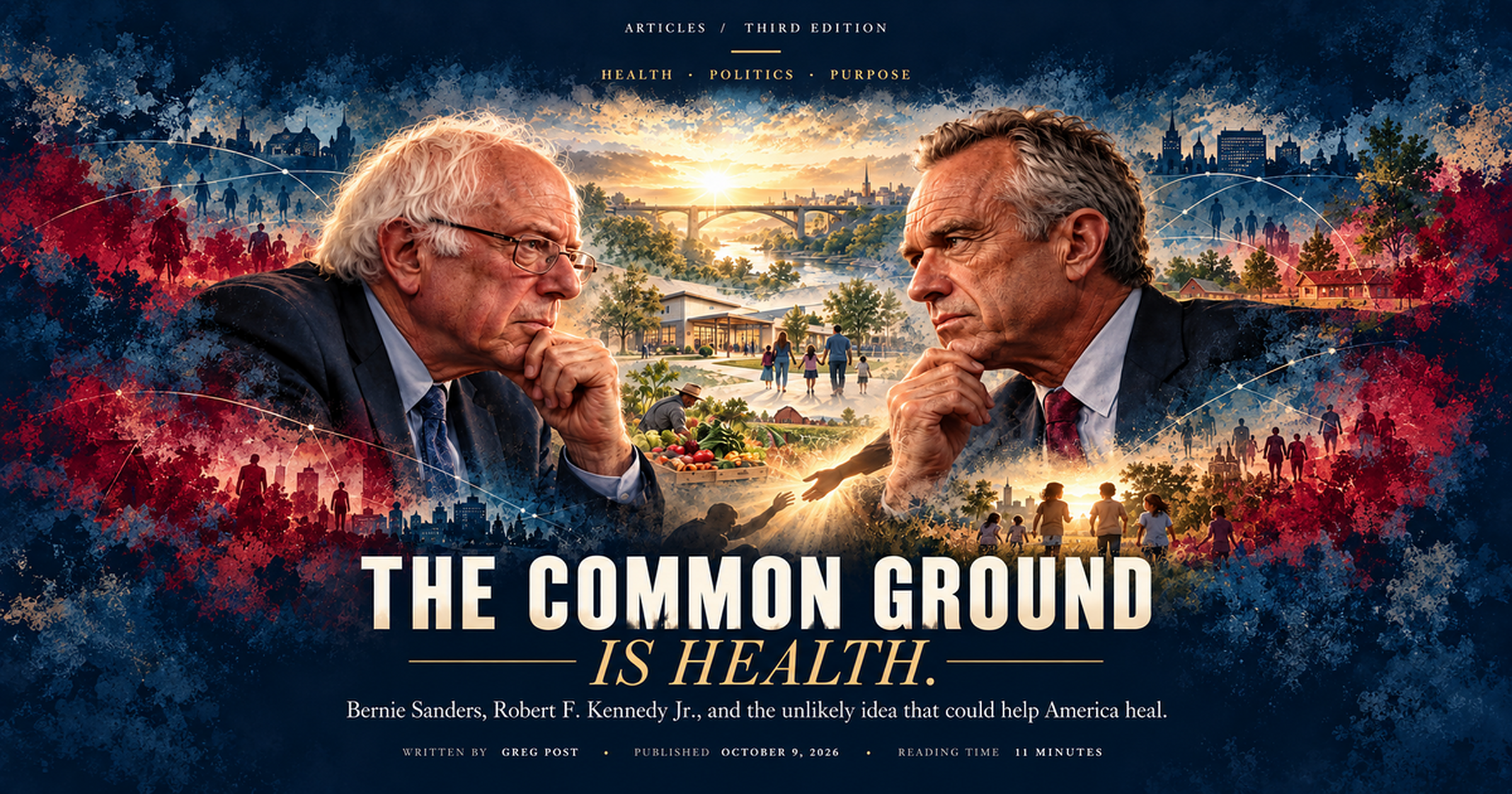
Bernie Sanders and Robert F. Kennedy Jr. are not allies.
Sanders voted against Kennedy’s nomination for secretary of Health and Human Services. He has since become one of Kennedy’s fiercest critics, particularly regarding vaccines, scientific oversight, and changes within federal health agencies.1
Those disagreements are real. They should not be hidden beneath some manufactured display of unity.
But beneath the political conflict is an opportunity worth recognizing.
For decades, Sanders has asked why Americans can lose access to medical care when they lose a job, become sick, or cannot afford an insurance company’s demands. His answer has remained remarkably consistent: health care should be guaranteed as a human right through Medicare for All.
Kennedy has approached the crisis from another direction. As secretary of Health and Human Services, he has centered his agenda on chronic disease, food quality, environmental exposure, addiction recovery, and the conditions making Americans sick in the first place.2
Sanders keeps asking: How do we guarantee care when people become sick?
Kennedy keeps asking: Why are so many people becoming sick?
America desperately needs to answer both.
01Two Halves of a Health System
In 2025, Sanders again introduced the Medicare for All Act, proposing a federally administered insurance program covering every American without premiums, deductibles, or copayments.3
His argument is fundamentally about access. A person should not avoid a doctor because of money. A family should not face bankruptcy because someone develops cancer. Employment should not determine whether a child receives medical treatment.
That is one half of health justice.
Kennedy’s central argument is about prevention. HHS has pursued changes involving food additives, petroleum-based synthetic dyes, the oversight of ingredients considered “generally recognized as safe,” and the role of ultra-processed food in America’s chronic-disease crisis.4
That is the other half.
Coverage without prevention risks becoming an enormously expensive system for managing preventable disease after it has already taken hold.
Prevention without universal access risks becoming a lecture delivered to people who still cannot afford a doctor, obtain treatment, or take time away from work.
Guarantee care for every American—and build a country that helps fewer Americans become sick in the first place.
Ending chronic disease would not magically make Medicare for All free. Prevention does not always reduce spending immediately, and some preventive interventions improve or extend life without lowering total lifetime medical costs.
But chronic illness is unquestionably one of the largest drivers of American medical spending. The CDC identifies chronic disease as a leading cause of illness, disability, death, and health-care costs in the United States.5
A healthier population would make any universal system stronger and more sustainable.
That should not be a left-wing or right-wing idea. It is basic math.
02The Business of Being Unhealthy
We need to speak honestly about the industries surrounding American health without reducing everything to a conspiracy.
There does not need to be a secret room where powerful people decide to make the country sick. Incentives can produce destructive outcomes without everyone participating in a coordinated plan.
Companies make money selling inexpensive, highly engineered food designed for convenience, shelf life, and repeated consumption. Other companies make money treating the chronic conditions associated with an unhealthy population. Insurance companies, pharmaceutical manufacturers, hospital systems, food corporations, advertisers, and government regulators operate inside systems that frequently reward treatment more reliably than prevention.
That does not make every company corrupt, every medication unnecessary, or every physician compromised.
It does mean we have built an economy capable of profiting at nearly every stage of declining health.
An NIH-controlled study found that participants eating an ultra-processed diet consumed more calories and gained weight compared with when those same people ate a minimally processed diet—even though the provided diets were matched for calories, sugar, fat, sodium, fiber, and macronutrients.6
The answer is not as simple as telling everyone to make better choices.
People need time to prepare food. Families need access to affordable ingredients. Children need truthful nutrition education. Communities need safe places to move, gather, and play. Farmers and small producers need a fighting chance against corporations capable of dominating shelves and advertising.
Still, there is profound truth inside a very simple instruction:
Eat real food.
It is not an entire health policy. It is a powerful place to begin.
03The Illness Beneath the Illness
Food and medical access are only part of the picture.
America is also suffering from a crisis of meaning.
Too many people feel disconnected from their work, their neighbors, their families, and any larger sense of purpose. We have mistaken constant communication for genuine connection. We can reach almost anyone instantly while feeling increasingly unknown.
The CDC reports that approximately one-third of American adults experience loneliness and that social isolation and loneliness increase the risk of serious mental and physical health conditions.7
Political division feeds that sickness. When neighbors are taught to see one another as enemies, distrust becomes a permanent emotional state. Anger provides temporary purpose. Outrage creates community without requiring intimacy.
Addiction can grow inside that emptiness.
Kennedy’s personal history gives him an unusual perspective on this part of the crisis. He has spoken publicly about his years of addiction and recovery, emphasizing community, spiritual connection, and purpose as essential parts of healing.8
Sanders approaches the same terrain through economic dignity. For decades, he has argued that people need health care, decent wages, secure housing, education, and the belief that their government has not abandoned them to corporate power.
These are different political languages describing overlapping human needs.
People need care.
People need agency.
People need community.
People need to believe their lives matter beyond what they produce, purchase, or post.
04An Honest Bridge Requires Disagreement
Bringing these two visions together cannot mean abandoning scientific standards or refusing to question government and industry.
Kennedy’s critics—including Sanders—have raised serious concerns about his handling of vaccine policy, staffing decisions, and federal health institutions. Sanders went considerably further than polite disagreement, calling for Kennedy’s resignation in 2025.9
That history cannot be airbrushed away.
Nor should Kennedy’s supporters dismiss every criticism as proof of corruption. Skepticism becomes useful only when it remains willing to examine evidence, admit error, and apply the same standard to its own side.
The bridge between these men would not be agreement on everything.
It would be agreement that Americans are unnecessarily sick, financially vulnerable, spiritually exhausted, and deserving of something better.
Sanders could challenge Kennedy’s movement to protect universal access, scientific integrity, workers, and vulnerable populations.
Kennedy could challenge Sanders’s movement to confront the food system, environmental exposure, institutional conflicts of interest, and the limits of a model focused primarily on paying for treatment.
They would restrain each other’s blind spots. That is what healthy political cooperation should do.
05The Generation That Watched Everything Change
Both men belong to a generation shaped by extraordinary promise and extraordinary trauma.
The Baby Boom generation was raised during the Cold War. Millions of schoolchildren were taught to “duck and cover” in preparation for nuclear attack. It became America’s first television generation. The violence of Vietnam entered living rooms as war was broadcast with an immediacy the public had never experienced before.10
Then came the assassinations.
John F. Kennedy.
Martin Luther King Jr.
Robert F. Kennedy.
National optimism collided repeatedly with public horror.
We often speak about generational trauma as though it only belongs to individuals and families. Entire generations can also carry unresolved fear. It can appear as cynicism, emotional distance, addiction, obsession with control, or the belief that hope is merely naïveté waiting to be punished.
But the Boomers were also shaped by civil rights, music, experimentation, antiwar movements, environmental awareness, and a belief that society could become more humane.
Robert F. Kennedy Sr. believed that countless acts of individual courage could combine into a force capable of breaking down seemingly immovable walls.11
That challenge still stands.
Perhaps the final great contribution of the Boomer generation is not proving which faction was right.
Perhaps it is demonstrating that people who profoundly disagree can still recognize a shared emergency and build something together.
06A Different Kind of Political Moment
Imagine a national health movement built around several basic commitments:
Every American can receive necessary medical care without financial ruin.
Preventive health becomes as important as treating advanced disease.
Food policy favors nourishment, transparency, and independent science.
Children are protected from commercial incentives that benefit from unhealthy habits.
Addiction is treated as a crisis involving health, meaning, trauma, and community—not merely criminality or personal weakness.
Scientific institutions remain transparent, accountable, and protected from both corporate capture and political manipulation.
Americans are invited to participate in improving their health rather than being managed as patients, consumers, or voting blocs.
None of those commitments requires complete ideological agreement.
They require maturity.
Technology now allows us to witness suffering and possibility across the world in real time. That exposure can overwhelm us, divide us, or wake us up. Used well, it can turn humanity into something closer to a world community—one capable of learning from cultures, treatments, food systems, and forms of social connection beyond our immediate experience.
But no technology can manufacture the courage to trust one another again.
That work remains human.
07Let Them Become the Bridge
Bernie Sanders has spent his life demanding that economic power answer to human dignity. He reshaped American politics by refusing to stop talking about inequality, corporate power, and health care as a human right.
Robert F. Kennedy Jr. has brought chronic disease, food ingredients, addiction, and institutional distrust into a national conversation that too often treated sickness as inevitable.
Neither man is beyond criticism.
Neither man possesses the entire answer.
That is precisely the point.
America does not need another hero onto whom we project all our hope. It needs leaders strong enough to contribute what they understand, humble enough to confront what they do not, and courageous enough to work beside people they may never fully trust.
Sanders and Kennedy may never become partners. Their current conflict makes that possibility seem remote.
But the two movements surrounding them already contain pieces of the same future.
One insists that no person should be denied care.
The other insists that a nation this sick must start investigating why.
Bring those truths together and we could create more than a new health-care policy. We could create a shared national purpose.
We could grow food differently.
Build healthier communities.
Treat addiction with dignity.
Restore trust through transparency.
Guarantee care.
Prevent suffering.
And show younger generations that disagreement does not have to end in destruction.
The Baby Boom generation has lived through fear, war, assassination, cultural revolution, technological transformation, and more than fifty years of political fracture.
It still has time to show us what it was always capable of.
Not another victory over the other side.
Something much harder.
Healing together.
Sources
- Sanders Statement on Voting “NO” on RFK Jr., Office of Senator Bernie Sanders, February 4, 2025.
- Make America Healthy Again, U.S. Department of Health and Human Services.
- Sanders, Jayapal, Dingell Introduce Medicare for All, Office of Senator Bernie Sanders, April 29, 2025.
- HHS Announces Food-Policy and GRAS Reforms, U.S. Department of Health and Human Services, August 10, 2026; and HHS and FDA Measures on Petroleum-Based Synthetic Dyes, April 22, 2025.
- Health and Economic Costs of Chronic Conditions, Centers for Disease Control and Prevention.
- NIH Study Finds Heavily Processed Foods Cause Overeating and Weight Gain, National Institutes of Health, May 16, 2019.
- Health Effects of Social Isolation and Loneliness, Centers for Disease Control and Prevention.
- Secretary Kennedy at the RX and Illicit Drug Summit, U.S. Department of Health and Human Services, April 24, 2025.
- Kennedy Must Resign, Senator Bernie Sanders, August 30, 2025; and Sanders Calls for Investigation into Vaccine Committee Firings, June 16, 2025.
- Children as Topic No. 1, National Archives; and Vietnam: The First Television War, National Archives History Office.
- Day of Affirmation Address, University of Cape Town, Robert F. Kennedy, June 6, 1966, John F. Kennedy Presidential Library and Museum.
EDITORIAL NOTE Written by Greg Post with AI-assisted editing, research organization, and visual design. All arguments and final editorial decisions are the author’s.